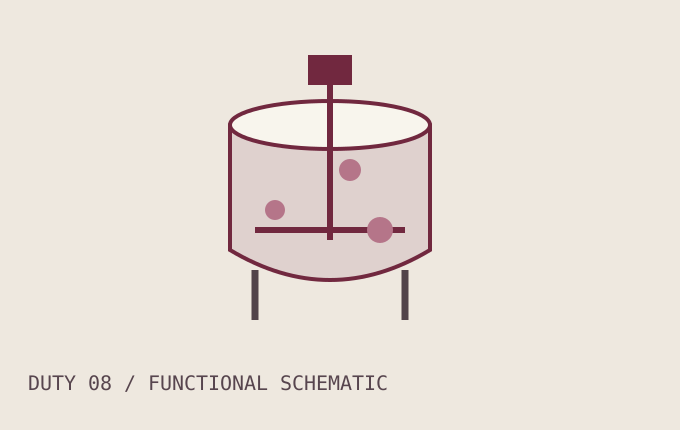
Particle-preserving agitation
Move heat and ingredients while keeping the agreed fruit pieces.
Carry the cooked batch to the filler without losing its texture.

Finished jam at a stated temperature, viscosity and particle condition.
Controlled delivery to the receiving hopper or filler.
Evaluate a suitable positive-displacement or other demonstrated product transfer arrangement. Ask for the pump and line clearances, pressure limits and evidence at the actual filling temperature.
Pipe diameter, length, bends, valves and inlet conditions matter as much as the pump. Fruit pieces must pass the complete path; a large pump port does not remove a restrictive valve downstream.
Measure discharge time and retained mass. Avoid turning a waiting hopper into an unvalidated extra hold, and coordinate low-level detection and filler demand.
| Parameter | Required basis |
|---|---|
| Product state | Temperature, viscosity method and particles |
| Duty point | Required rate against actual line resistance |
| Product recovery | Retained mass and accepted recovery method |
Define drainability, safe pressure release, seal inspection and dismantling required beyond automated cleaning.
A water flow curve is not a jam-throughput or particle-integrity guarantee.
Move heat and ingredients while keeping the agreed fruit pieces.
Prove the package with the product the line actually makes.