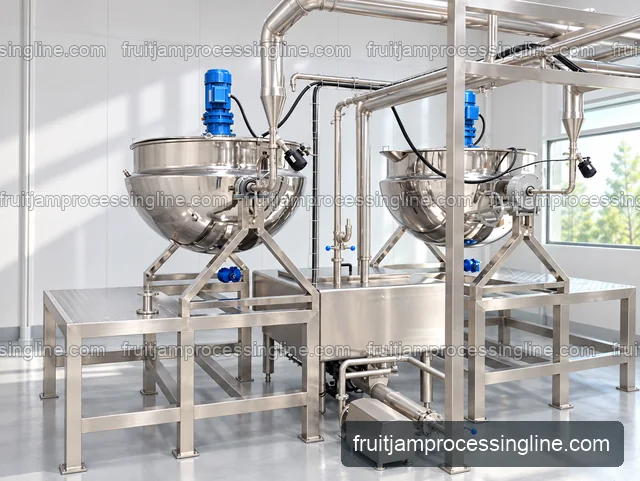
Jacketed jam cooking kettle
Compare accessible batch cooking with the product’s heat exposure.
Compare an open jacketed jam kettle with an engineered vacuum cooker by system scope, site services and recipe acceptance.
Selection guides
Compare an open jacketed jam kettle with an engineered vacuum cooker by system scope, site services and recipe acceptance.
Discuss this applicationThe equipment shown is a machine-family reference; the final configuration is selected for your product.
An atmospheric arrangement uses an open jacketed vessel and the specified mixing, heating and discharge system. A vacuum arrangement requires its own vessel configuration, controlled pressure, vapour path, condenser, vacuum source and equalisation provisions. These alternatives should not be presented as two mandatory cooking vessels in every jam line.
Ask how each arrangement handles minimum and maximum charge, changing viscosity, foaming, mixing and discharge. The comparison should also identify available heating and cooling services, access and cleaning responsibilities. Reduced pressure changes the boiling condition; it does not by itself prove a shorter complete cycle or validate the packed product's preservation.
Provide the recipe, inlet condition, accepted finished mass, endpoint checks, pack and full load-to-ready cycle. Compare the offered system scope and utility requirements alongside the product result. The open kettles shown are real equipment references; no image here is being used to claim a verified vacuum model or universal rated output.
Compare accessible batch cooking with the product’s heat exposure.
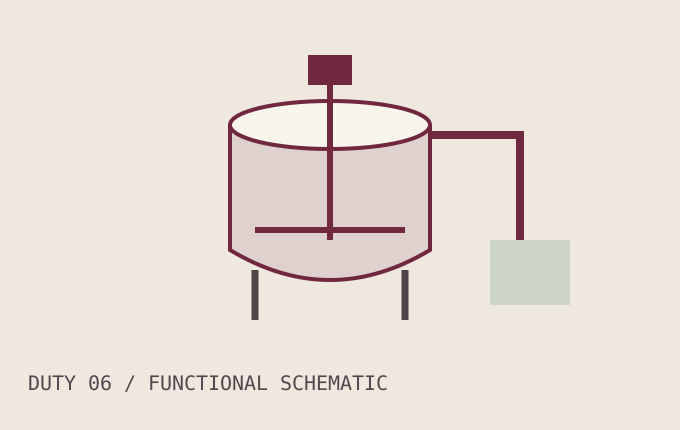
Lower the boiling pressure with a complete vapour-side design.
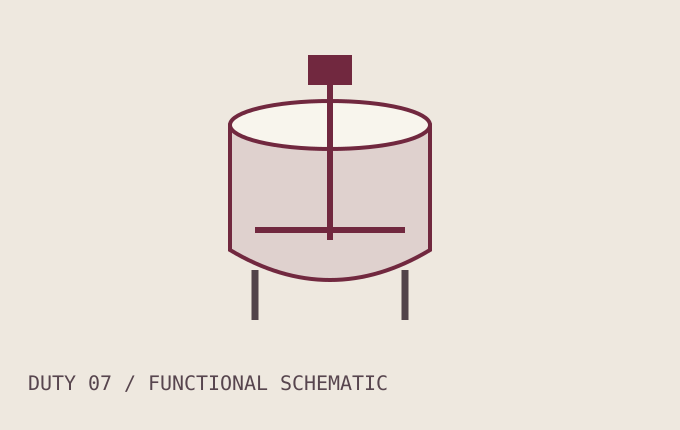
Keep a smooth viscous batch moving across the heated surface.